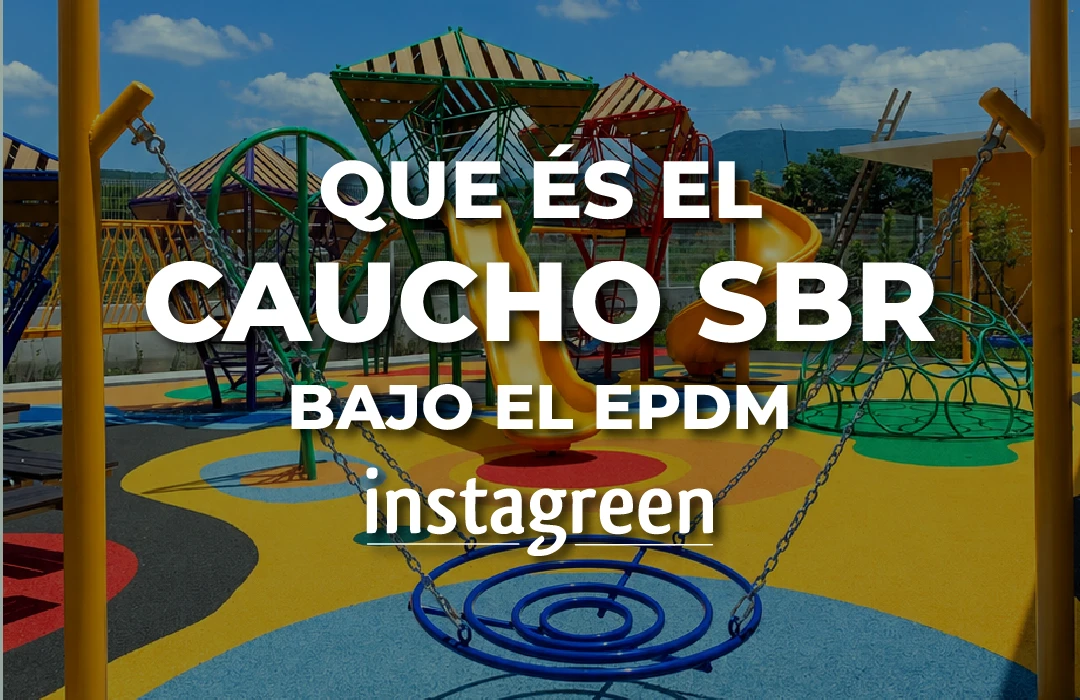
When reviewing a playground or sports area plan with cast rubber flooring, it's common to find something like:
– 30 mm SBR base.
– 10 mm EPDM layer.
Or variations in thickness depending on the project.
But what exactly is SBR? Why is it placed under the EPDM? And what impact does it have on the safety and performance of the surface?
In this article, we'll clarify these points simply, while maintaining the necessary technical focus to make informed decisions.
WHAT IS SBR RUBBER?
SBR stands for Styrene-Butadiene Rubber. In the context of cast rubber flooring:
– It typically uses recycled rubber granules (from tires).
– It's mixed with a specific resin to form the base layer.
– It acts as the primary impact absorber.
In other words, SBR is the system's primary "shock absorber."
WHAT IS EPDM RUBBER AND WHY IS IT ON TOP?
EPDM (Ethylene Propylene Diene Monomer):
– Is a high-quality synthetic rubber.
– Is manufactured in color-stable granules.
– Is mixed with resin to form the visible layer exposed to use and the elements.
Its main functions are:
– To provide color and a final finish.
– To protect the SBR base from the elements.
– To withstand wear and cleaning.
SBR does not have the same color performance or surface resistance as EPDM, which is why it is not left exposed.
HOW SBR + EPDM WORK TOGETHER
In a typical system:
– The SBR layer is responsible for:
– Absorbing impacts.
– Providing the necessary thickness to meet safety requirements (depending on the fall height).
– The EPDM layer is responsible for:
- Protecting the SBR.
- Providing the flooring's aesthetic appeal (color, patterns).
- Offering a suitable surface texture for its intended use.
It's a team effort: without sufficient SBR, the surface loses its cushioning capacity. Without EPDM, the flooring degrades faster and loses its appearance.
RELATIONSHIP BETWEEN THICKNESS AND SAFETY
The total thickness of the system, defined by the SBR + EPDM combination, is associated with:
- The critical fall height that the flooring can help cushion within defined ranges.
- The type of equipment that will be placed on the flooring (swings, slides, tall structures).
Greater equipment heights:
- Typically require a greater thickness of SBR.
- This means more material and a more robust design.
That's why not all EPDM rubber flooring is the same: a decorative floor in a flat area doesn't have the same requirements as one under a tall play structure.
OTHER IMPORTANT FACTORS IN SYSTEM DESIGN
In addition to thickness, the following are important:
– The base on which it is installed:
– Concrete, asphalt, or other well-executed systems.
– The quality of the resin:
– Affects durability, flexibility, and resistance.
– The installation:
– On-site mixing.
– Compaction and leveling.
– Curing.
A poorly executed system, even using good materials, can fail prematurely.
COMMON MYTHS
“As long as it has EPDM on top, everything is fine.”
Not exactly. A floor may look very nice on the surface but:
– Have an insufficient SBR base.
– Not meet the expected cushioning levels.
– Deteriorate faster because the base or resin was not designed correctly.
“All rubber is the same.”
It isn't. The origin, particle size, and quality of the SBR, as well as the quality of the EPDM and resins, make significant differences in:
– Durability.
– Color stability.
– Mechanical performance.
WHAT TO ASK A SUPPLIER
Before approving an SBR + EPDM system, it's advisable to ask:
– What thicknesses they propose and based on what parameters.
– The origin of the SBR and EPDM.
– What type of resin they use.
– How they recommend maintaining the flooring over time.
– What similar projects they have completed.
WHEN DOES IT MAKE SENSE TO WORK WITH INSTAGREEN?
When the objective is to:
– Protect children in play areas.
– Meet safety and functionality criteria.
– Design a floor that is both decorative and technical.
It makes sense to work with a team that masters the entire system, not just the "colored granules."
RubberFloor, by InstaGreen, integrates design, base, SBR, EPDM, and installation to achieve safe and durable surfaces in Costa Rica.