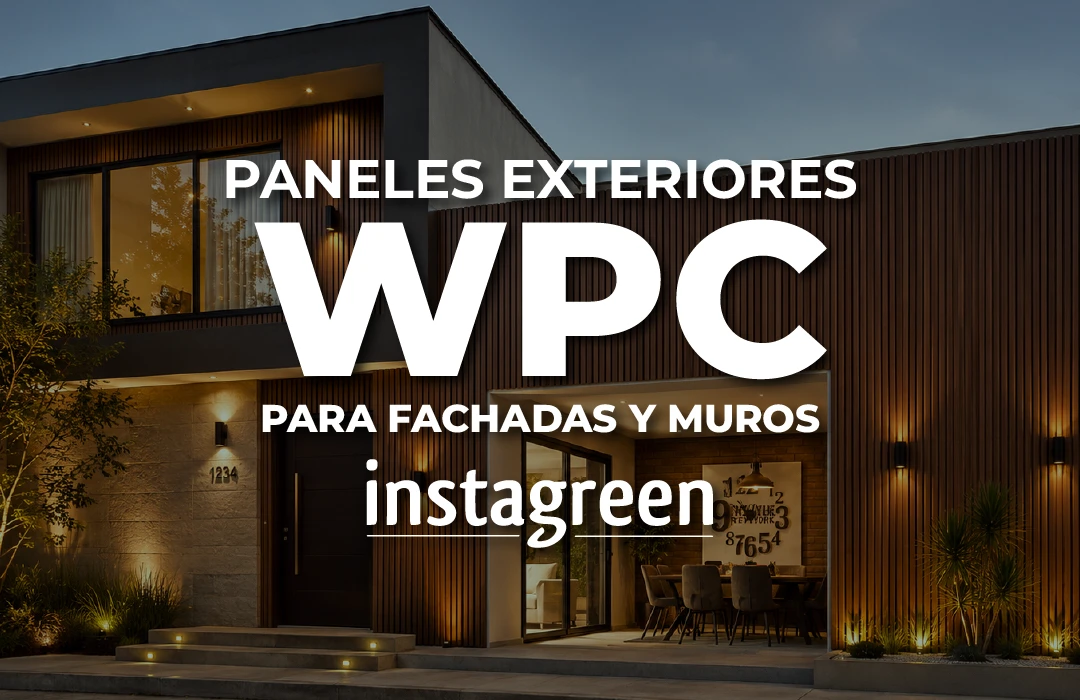
Exterior walls and facades in Costa Rica face the worst possible combination of elements: strong sun, heavy rain, temperature fluctuations, and often little to no maintenance.
Natural wood looks great, but:
– It rots if not protected.
– It requires varnish or paint frequently.
– It is susceptible to fungi and insects.
WPC exterior panels were created precisely to solve this problem: maintaining a warm, wood-like aesthetic, but with the stability of a composite material designed for outdoor use.
WHAT IS WPC AND WHY DOES IT MAKE SENSE FOR EXTERIORS?
WPC stands for Wood Plastic Composite. It is a composite of:
– Plant fibers (such as wood or bamboo, depending on the technology).
– Polymers (plastic).
– Additives that improve stability, color, and UV resistance.
The goal is to combine the best of both worlds:
– From the plant side:
– Visual texture and feel closer to wood.
– From the plastic side:
– Moisture resistance.
– Reduced risk of rot.
– Less maintenance.
Unlike traditional wood, WPC:
– Doesn't rot in the rain.
– Doesn't require frequent varnishing to prevent deterioration.
– Is much more stable outdoors when installed correctly.
TYPES OF APPLICATIONS WITH WPC EXTERIOR PANELS
Some typical applications:
– Complete or partial facades of houses and buildings.
– Feature walls on terraces and social areas.
– Ceilings in porches, corridors, and entrances.
– Decorative pergolas and sunshades.
– Lightweight enclosures for balconies and railings.
In many cases, WPC is combined with flexible stone, exposed concrete, glass, and metal in walls to achieve contemporary facades.
ADVANTAGES OVER TRADITIONAL WOOD
Without being at odds with wood, it's important to recognize the differences:
Natural wood:
– Very warm, with unique and unrepeatable grain patterns.
– Requires protective systems against sun, rain, fungi, and insects.
– Needs regular maintenance if exposed to the elements.
Exterior WPC:
– Wood-like appearance, but more uniform and predictable.
– Doesn't rot or deteriorate in the rain.
– Doesn't require frequent varnishing to survive.
– Is more dimensionally stable in the face of climate changes.
In projects where the client is unwilling to assume intensive maintenance, WPC is often the most sensible option for facades and decorative walls.
DOES WPC FADE OR DAMAGE IN THE SUN?
Like any material permanently exposed to the elements, WPC:
– Will experience a slight change in tone during the first few months of exposure.
– Then tends to stabilize.
In quality products:
– This change is gradual and uniform.
– No “spots” or unusual streaks are visible.
– The piece does not lose its integrity or crumble.
In low-quality products:
– The color may fade more aggressively.
– There may be warping, buckling, or cracking.
That's why it's important to work with suppliers who:
– Provide technical data sheets.
– Offer warranties.
– Have real projects installed in Costa Rica.
HOW ARE WPC EXTERIOR PANELS INSTALLED?
It's not siding that can be glued directly to the wall with any adhesive. A well-designed system typically includes:
– Secondary structure:
– Metal or another suitable material.
– Fixed to the base wall (block, concrete, etc.).
– Specific clips or fixing systems:
– Allow for controlled expansion.
– Conceal screws for a clean finish.
– Separation from the wall:
– Creates an air gap.
– Aids ventilation and thermal performance.
A well-designed installation respects:
– Joints between pieces.
– Expansion according to panel length.
– Manufacturer's recommendations regarding support and fixing distances.
DOES IT REQUIRE MAINTENANCE?
Compared to wood, exterior WPC:
– Does not need protective varnishes or paints to prevent rot.
– Does not peel or splinter like some woods when they deteriorate.
What may be advisable:
– Washing periodically to remove dust and dirt.
– Avoiding strong impacts with metal or sharp objects.
It requires significantly less maintenance and is more predictable than wood exposed to the elements.
WHEN TO USE WPC EXTERIOR PANELS IN COSTA RICA
It makes perfect sense when:
– You want a warm, wood-like facade, but you know you won't be performing constant maintenance.
– The project is located in areas with high sun exposure and heavy rainfall.
– The end client wants something "beautiful and practical" rather than a handcrafted piece of exterior carpentry.
– Design coherence is desired between exterior flooring (decking) and walls, using compatible materials.
WHEN IT MAKES SENSE TO WORK WITH INSTAGREEN
A WPC exterior panel system is more than just "buying sheets." It includes:
– Defining the appropriate structure.
– Addressing connections with other materials.
– Designing details for corners, finishes, and changes in plane.
InstaGreen works with corrugated WPC panels and exterior decking designed for tropical climates, providing support in design, construction details, and installation to ensure your facade looks great from day one and for many years to come.