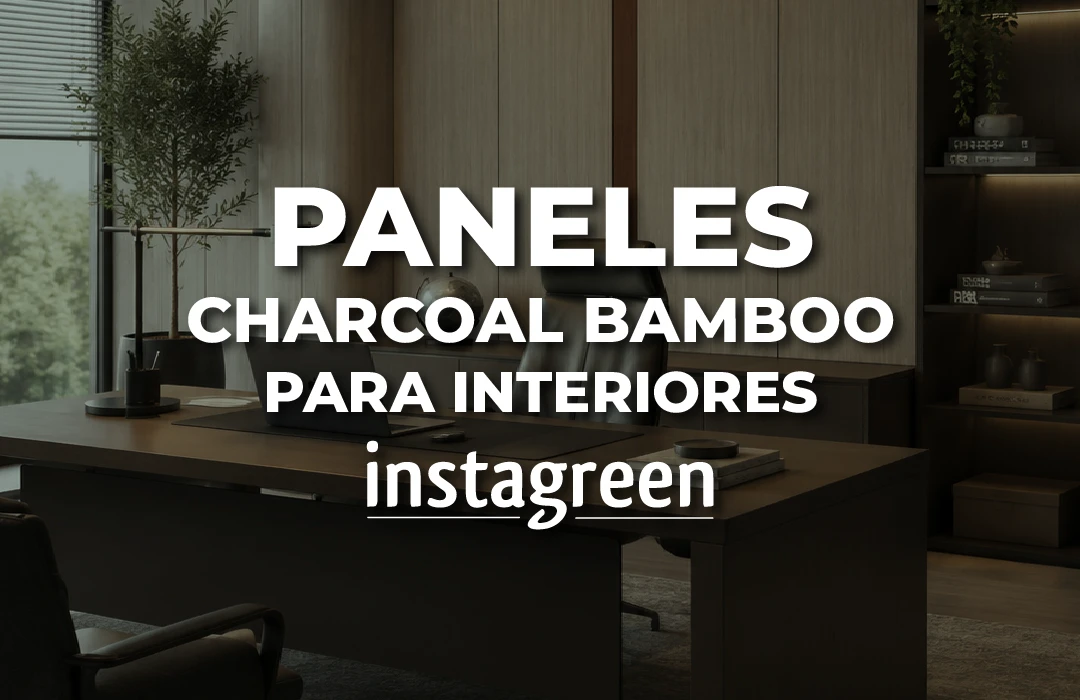
In addition to grooved MDF panels, other technologies have gained prominence in interior design: Charcoal Bamboo panels and WPC interior panels.
These solutions, when properly specified, offer:
– A highly polished and contemporary look.
– Potential for acoustic improvement depending on the system and substrate.
– Greater dimensional stability in the face of relative humidity variations (compared to solid wood).
In this article, we will focus on:
– What Charcoal Bamboo panels and WPC interior panels are.
– How they are installed in practice.
– When they are the better choice than other solutions.
– What details to consider to achieve a professional result.
WHAT ARE CHARCOAL BAMBOO PANELS?
Although each manufacturer has its own specific formulation, generally speaking, they are:
– Composite panels that blend fibers (such as bamboo, charcoal, and other components) with resins.
– Designed for interior use on walls, ceilings, or decorative elements.
– Available in different textures, colors, and surface designs.
Their goal is to offer a piece that is:
– Dimensionally stable.
– With good surface properties.
– Allowing for designs with relief, grooves, or special textures.
WHAT ARE WPC PANELS FOR INTERIORS?
WPC panels for interiors:
– Use the same composite principles (fibers + polymers) but are specifically designed for interior environments.
– Available as:
– Decorative panels.
– Modular slats.
– They are designed to combine strength, appearance, and ease of maintenance.
Indoors, rain resistance is not as crucial as outdoors, but the following are important:
– Stability against moderate humidity changes.
– Good surface finishes that don't require constant varnishing.
ADVANTAGES OVER TRADITIONAL MATERIALS
Compared to solid wood:
– Lower risk of movement (swelling, shrinkage) in large-format pieces.
– More controlled surfaces in terms of color and texture.
– Less maintenance required with varnishes.
Compared to simply painted walls:
– Significantly greater visual presence.
– Possibility of incorporating relief, channels, or textures that enhance the perception of space.
– Better interaction with decorative lighting.
ACOUSTIC ASPECTS
Depending on the design and installation method, these panels can:
– Help reduce sound reflections in rooms, offices, and shops.
– They can be part of systems with improved acoustic performance when combined with:
- Absorbent underlays.
- Air gaps.
- Specific materials behind the panel.
Not all decorative panels are certified acoustic products, but they can contribute to improved acoustic comfort compared to a completely hard, smooth wall.
HOW TO INSTALL CHARCOAL BAMBOO AND WPC INTERIOR PANELS
Installation can be done:
– Direct to the wall:
– With adhesives recommended by the manufacturer.
– With spot mechanical fixings as needed.
– On frames or substructures:
– When aligning very irregular walls.
– When creating an air gap or integrating concealed lighting.
Details to consider:
– Properly design panel joints so the pattern appears continuous.
– Address corners, changes in plane, and junctions with ceilings and floors.
– Plan where electrical installations will be accessed, if any.
LIMITATIONS AND BEST PRACTICES
Although these materials are very versatile, it is important to:
– Not treat them as if they were permanent outdoor panels (they are not designed for direct rain).
– Follow the recommendations for fixing, cutting, and drilling.
– Avoid strong impacts or improvised cuts that could damage the coatings.
WHERE DO THEY MAKE THE MOST SENSE?
– Modern offices seeking a contemporary design language.
– Building and hotel lobbies.
– Retail spaces that need a clean and elegant backdrop for product or branding.
– Mid-to-high-end homes looking to upgrade specific areas (living room, dining room, master bedroom).
WHEN DOES IT MAKE SENSE TO WORK WITH INSTAGREEN?
The value of these panels increases when integrated into a larger project:
– Where foliage, interior panels, exterior WPC, flexible stone, and other materials are combined.
Where lighting and furnishings are designed from the outset as integral parts of the overall aesthetic.
InstaGreen assists architects, designers, and end clients in selecting Charcoal Bamboo and WPC interior panels, carefully considering both specifications and installation details.