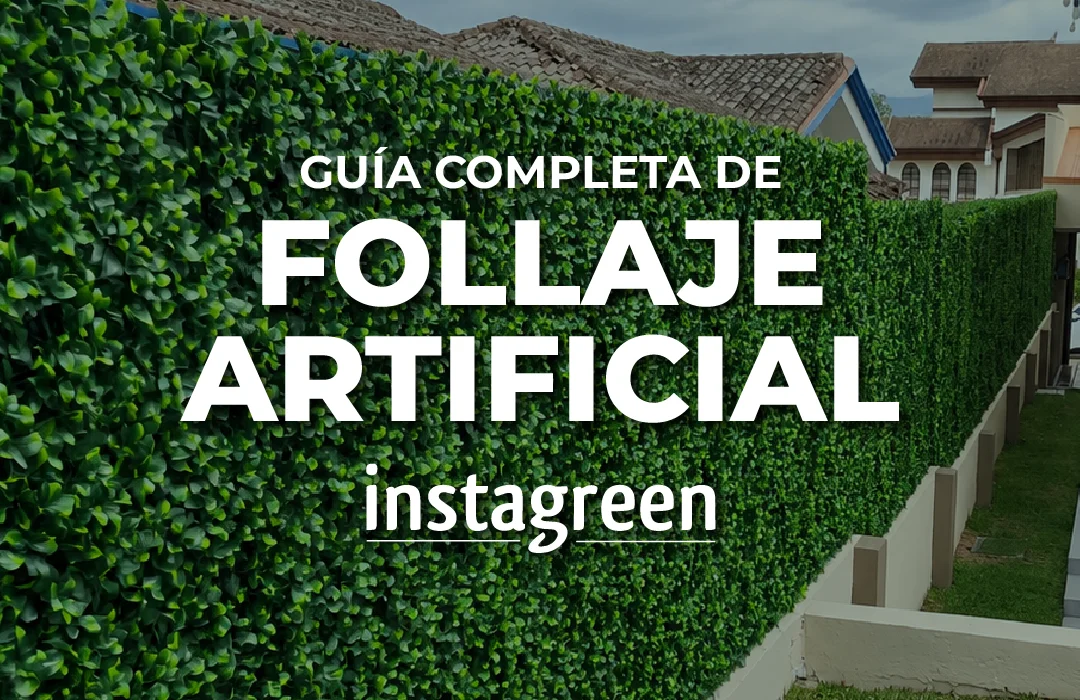
We're seeing more and more perfect green walls in condominiums, shopping centers, restaurants, and homes in Costa Rica. In most cases, these aren't natural walls, but rather well-executed projects using high-quality artificial foliage.
The tropical climate, intense sun, and maintenance costs make artificial foliage a very logical solution: it allows for spectacular green walls, vertical gardens, and terraces without the hassle of watering, fertilizing, pruning, or pests.
In this guide, we explain, in simple language but with technical expertise:
– What types of artificial foliage exist and when they are used.
– How long they last, whether they fade or "brown" in the sun.
– How they are sold and how they are installed in practice.
– In which projects they make more sense than natural green walls.
TYPES OF ARTIFICIAL FOLIAGE YOU CAN USE IN COSTA RICA
Within high-quality artificial foliage, we can identify four main categories. Each addresses a different design need.
Artificial Vines for Continuous Walls
Artificial vines are interwoven panels of foliage that allow you to cover large surfaces uniformly. They are ideal for:
– Walls of houses and condominiums.
– Perimeter fences.
– Walls you want to cover because they look old or untidy.
– Areas where you need quick privacy.
At InstaGreen, vines are one of the brand's biggest cash cows because they solve the classic problem of the "ugly wall" without heavy construction and without waiting months for a natural plant to grow.
Artificial Vertical Gardens as a Focal Point
Artificial vertical gardens combine different types of leaves, textures, and depths on a single panel. They aim not only to provide cover but also to become the visual focal point of the space.
They are perfect for:
– Restaurants, cafes, and bars that want an Instagrammable backdrop.
– Building lobbies and reception areas.
– Terrace and balcony walls where you want something highly decorative.
– Backdrops for photography, branding, and digital content.
While climbing plants function as a "uniform green wall," artificial vertical gardens function as a "living picture" or design piece.
Hanging Plants for Ceilings and Pergolas
Artificial hanging plants are individual elements that are attached to beams, pergolas, metal structures, or ceilings. They create a cascading and dynamic effect and help to visually lower the height of a space.
They combine beautifully with climbing plants or vertical gardens on:
– Terraces.
– Outdoor walkways.
– BBQ or social areas.
Artificial decorative plants for indoors
Artificial decorative plants are individual models such as ferns, palms, or shrubs that are placed in pots or planters.
They are ideal for:
– Offices and waiting rooms.
– Living rooms and dining rooms.
– Commercial spaces and showrooms.
When there is insufficient natural light or time to care for live plants, artificial decorative plants allow you to have greenery year-round without worrying about watering, soil, or pests.
DOES ARTIFICIAL FOLIAGE FADE OR BURNT IN THE SUN?
This is the number one question in Costa Rica, and the honest answer is: it depends on the quality of the material and whether it actually has UV protection.
What about cheap products?
Very inexpensive foliage is often made with plastics without UV additives and without testing in tropical climates. The typical result after one or two years of direct sunlight is:
– Significant color loss, turning to yellowish or grayish tones.
– Leaves that become brittle, crystallize, and break easily.
– Panels that warp or break in the wind.
In the end, cheap becomes expensive because the entire installation has to be replaced much sooner than expected.
How Quality Foliage Performs Outdoors
Foliage designed for outdoor use should:
– Be made of quality polymers, such as HDPE, with UV protection additives.
– Be tested in climates with high solar radiation, such as Costa Rica.
– Offer a genuine manufacturer's warranty.
Under normal use, quality foliage maintains a good appearance for more than eight years, or even longer, with gradual and even fading, without burnt areas or crystallized leaves.
HOW LONG DOES ARTIFICIAL FOLIAGE LAST AND WHAT MAINTENANCE DOES IT NEED?
Typical Lifespan
With professional materials and proper installation, an outdoor artificial foliage wall can last:
– More than 8 to 10 years in good condition.
– Much longer indoors or in covered areas, where direct sunlight is less intense.
Actual Day-to-Day Maintenance
Compared to a natural green wall, artificial foliage requires minimal maintenance:
– It doesn't require watering, fertilizing, or pruning.
– It doesn't attract insects or generate dirt or mud.
– Only occasional cleaning with water or a damp cloth to remove dust is recommended.
– For large projects, an air blower can be used for quick maintenance.
In practice, the great advantage is that it always looks green and tidy, even if no one has time to care for plants.
HOW IS ARTIFICIAL FOLIAGE SOLD, BY THE SQUARE METER OR BY THE PIECE?
Climbing plants and vertical gardens are typically sold in modular panels. Each panel has a standard size, and the total square footage you need is calculated based on that.
In simple terms:
– For a wall, the price is measured in square meters.
– However, for inventory and logistics purposes, we work with panels or pieces.
On the other hand:
– Hanging plants and decorative plants are sold individually, depending on the model.
The important things for getting a quote are:
– Measuring the height and width of the area to be covered.
– Checking for cutouts, corners, columns, or gaps that would generate waste.
– Choosing the type of foliage (climbing plants, vertical garden, hanging plants, or a mix) according to the final effect you want.
HOW TO INSTALL ARTIFICIAL FOLIAGE ON WALLS, FACADES, AND PERGOLAS
Base support according to the type of surface
Depending on where it will be installed, different solutions are used:
– Concrete or block walls:
The most professional approach is to first fix a mesh or lightweight structure and then attach the foliage to that base. This better distributes the load and improves ventilation.
– Existing metal fences or mesh:
In many cases, the foliage can be fixed directly with cable ties or weather-resistant fasteners.
– Metal structures and pergolas:
Specific fastening systems or ties are used so that the foliage is not visible from the front, but remains secure against the wind.
Fasteners and important details
The installation should consider three things:
– That the fixing points are not visible from the front.
– That the system withstands wind and rain without coming loose.
– That the foliage can be removed or replaced in sections if necessary.
That's why it's important to work with a supplier who knows how to design both the aesthetic and the structural aspects.
WHERE DOES IT MAKE THE MOST SENSE TO USE ARTIFICIAL FOLIAGE?
Residential Uses
– Perimeter walls and fences in houses and condominiums.
– Walls of terraces, balconies, and BBQ areas.
– Areas around swimming pools, always taking care with the base and the fixing systems.
Commercial and Corporate Uses
– Facades of commercial premises and restaurants.
– Lobbies and reception areas of offices.
– Walls of meeting rooms, internal cafeterias, and break areas.
– Backdrops for social media content, videos, and brand photography.
Institutional Uses
– Private or public educational centers.
– Clinics, medical offices, and hospitals that want more welcoming spaces.
– Municipalities and urban intervention projects.
In all cases, the pattern repeats itself: high positive visual impact, low maintenance, and very good end-user perception.
ARTIFICIAL FOLIAGE VS. NATURAL GREEN WALL: WHICH IS BEST IN COSTA RICA?
Advantages and Challenges of Natural Green Walls
– Pros:
It's real biology, with living plants and ecological benefits.
– Cons:
It requires constant watering, drainage systems, fertilization, pest control, and frequent pruning.
If neglected, it looks unsightly very quickly.
The cost of maintenance in the medium term can be high.
Advantages of Quality Artificial Foliage
– It always looks green and uniform.
– It doesn't depend on watering, weather, or gardening staff.
– It allows control over density, leaf type, and design composition.
– It doesn't generate soil, mud, or insects.
In projects where:
– There's no budget for ongoing maintenance.
– Irrigation and drainage systems are not desired.
– A predictable and stable result over time is needed.
Artificial foliage is usually the most logical and cost-effective option.
WHAT YOU SHOULD ASK AN ARTIFICIAL FOLIAGE SUPPLIER IN COSTA RICA FOR
Before making a decision, it's a good idea to ask for:
– Specifications of the material and UV protection level.
– A written warranty and terms of use.
– Photographs or visits to projects installed several years ago.
– Recommendations on what type of foliage to use in each area of your project.
– A clear proposal for the structure and installation, not just the sale of individual panels.
WHEN IT MAKES SENSE TO WORK WITH INSTAGREEN
InstaGreen has been working with artificial foliage since 2013 and has developed specific lines for tropical climates, high sun exposure, and design-intensive projects.
It makes sense to work with a team like this when:
– You want someone to guide you through the concept design, not just the material sales.
– You need help combining climbing plants, vertical gardens, hanging plants, and decorative plants.
– You're looking for a supplier who understands both the aesthetic and technical aspects of installation.