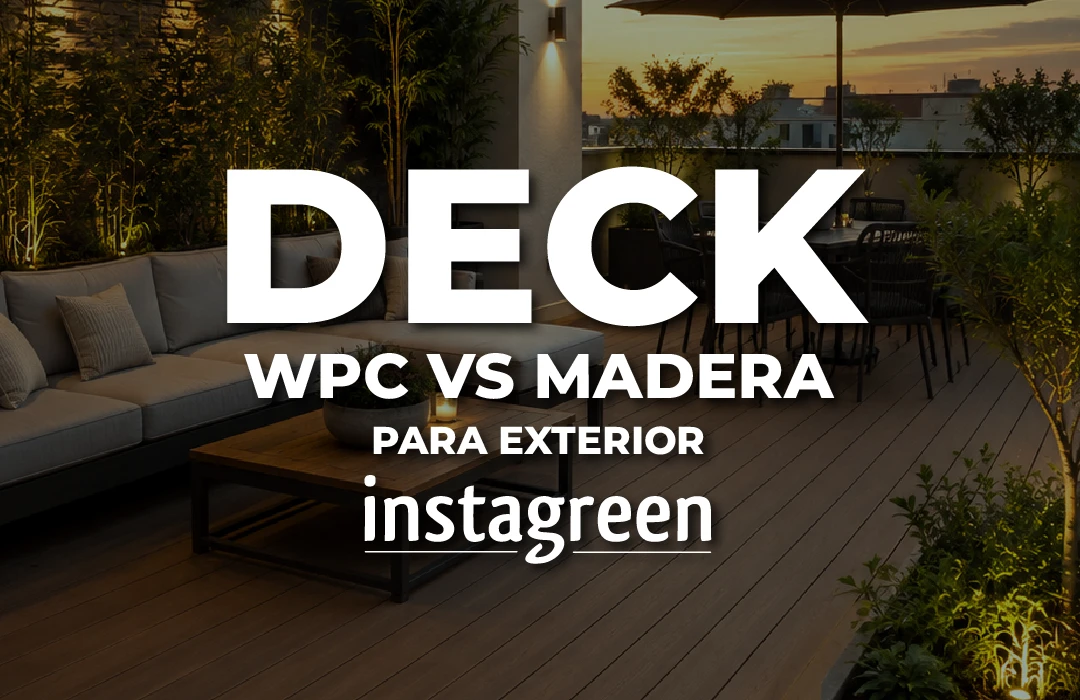
When a client asks for “a beautiful deck for the terrace or pool,” the conversation almost always reaches the same point: natural wood or WPC decking?
Both options can be valid, but Costa Rica’s tropical climate and the level of maintenance the client is willing to accept often tip the scales in favor of WPC.
In this article, we will calmly and objectively compare:
– How wood and WPC perform outdoors.
– What the actual maintenance of each option entails.
– How the lifespan is affected in a tropical climate.
– When each alternative makes sense.
USER EXPERIENCE: WHAT IT FEELS LIKE TO WALK ON EACH
Natural wood:
– Very warm and pleasant to the touch.
– Each board is unique in its grain and subtle details.
– If well maintained, it can look spectacular for many years.
WPC Decking:
– Texture designed for comfort under barefoot walking.
– Wood-like appearance, but more uniform.
– Less risk of splintering or fiber lift.
In both cases, the deck design and installation quality are just as important as the material itself in the final experience.
PERFORMANCE IN THE FACE OF WATER, SUN, AND HUMIDITY
The biggest difference becomes apparent when we consider:
– Heavy rain.
– Periods of intense sunlight.
– High ambient humidity.
Traditional Wood:
– Tends to absorb moisture.
– Can swell, warp, or crack.
– Is susceptible to fungi and insects if not properly protected.
WPC Decking:
– Much less absorbent.
– More dimensionally stable.
– Does not rot or serve as a food source for fungi or insects.
This doesn't mean WPC is indestructible, but it is less vulnerable to the typical problems of wood exposed to the elements.
REAL MAINTENANCE: WHAT NO ONE TELLS YOU IN THE QUOTE
Well-made exterior wood requires:
– Sealers, varnishes, or protective oils applied regularly.
– Spot or complete sanding when the finish deteriorates.
– Periodic inspections to address areas exposed to standing water or constant shade.
Outdoor WPC decking:
– Doesn't require varnishes or sealers to prevent rot.
– Generally, the following is sufficient:
– Regular cleaning.
– Removal of leaves and debris.
– In some cases, controlled pressure washing.
In residential projects where maintenance is often neglected or postponed, WPC tends to look better for longer with less intervention.
MEDIUM-TERM LIFESPAN AND AESTHETICS
Wood:
– With good construction design and proper maintenance, it can last for many years.
– Without maintenance, it deteriorates quickly: uncontrolled color changes, cracks, and rot in critical areas.
WPC Decking:
– It has an initial color change curve (which stabilizes after some time in the sun).
– It maintains its physical integrity more easily: it doesn't disintegrate due to moisture.
In quality products, it can have a long and predictable lifespan.
TOTAL COST OF OWNERSHIP, NOT JUST PRICE PER SQUARE METER
When you decide based solely on the price of the material per square meter, the comparison can be unfair.
Consider:
– Cost of the structure (substructure, fixings, etc.) in both cases.
– Maintenance costs over the years.
– Time and inconvenience associated with closing the deck for sanding, varnishing, or repairs.
For many clients, the deciding factor is:
– “I don’t want to be sanding and varnishing every few years; I want something that looks good with minimal maintenance.”
WHEN TO CHOOSE WOOD AND WHEN TO CHOOSE WPC DECKING
Wood makes more sense when:
– You’re looking for a very specific design project where natural wood is an essential part of the concept.
– The client is willing to accept frequent maintenance and understands the cost.
– You have access to carpentry professionals with experience in outdoor work.
WPC decking makes more sense when:
– You want low-maintenance terraces and pool areas.
– The client prioritizes durability and stability in tropical climates.
– You need a warm design aesthetic, but with more controlled risk management.
WHEN IT MAKES SENSE TO WORK WITH INSTAGREEN
Beyond the material, a good deck requires:
– The correct structure (spacing between supports, type of profiles).
– Appropriate fastening systems.
– Well-designed edge details, wall junctions, and drainage.
InstaGreen works with WPC decking systems and complementary solutions (foliage, turf, panels) to ensure your terrace, pool, or walkway functions as a cohesive and durable whole.