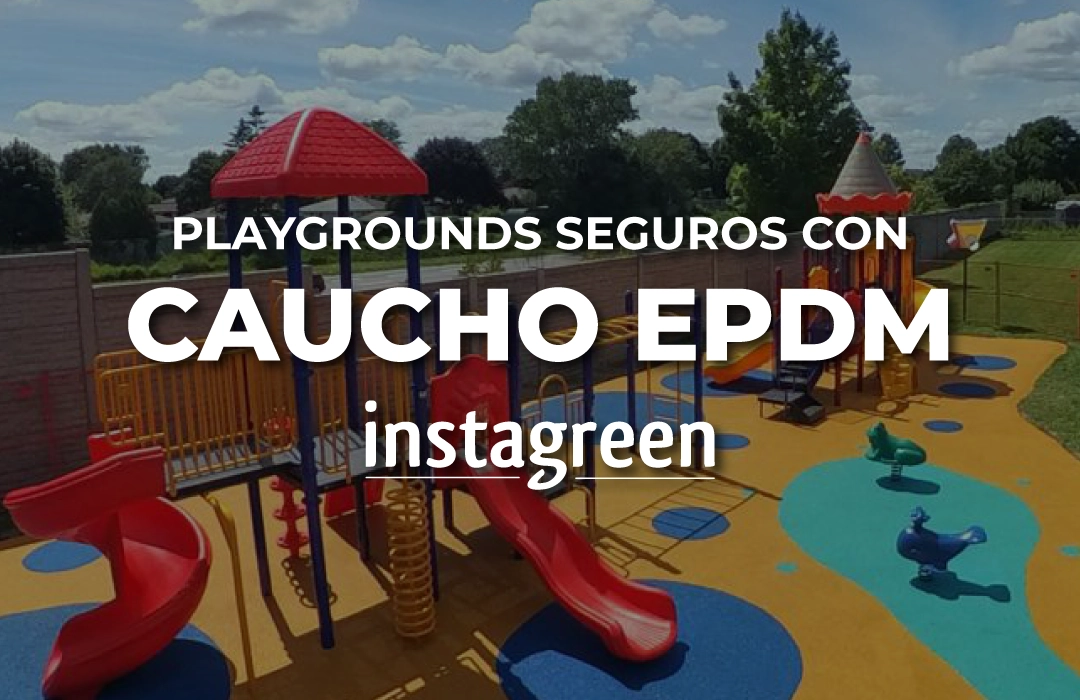
When we talk about safe surfaces for children's play areas in Costa Rica, cast-in-place EPDM rubber is one of the most comprehensive solutions.
Compared to options such as:
– Concrete.
– Hard tiles.
– Compacted earth or gravel.
– Deteriorated natural grass.
A well-designed SBR + EPDM rubber system:
– Reduces the risk of injury from falls within the range for which it was designed.
– Offers a continuous surface, without gaps that can open up.
– Allows for play with child-friendly colors and designs.
In this article, we will review:
– What the SBR + EPDM system consists of.
– What thickness means from a safety perspective.
– How the base is designed.
– What applications it has beyond playgrounds.
WHAT IS CAST-IN-PLACE EPDM RUBBER?
When we talk about “EPDM rubber for playgrounds,” we typically mean:
– Base layer:
– Recycled, granulated SBR rubber.
– Blended with resin.
– Provides impact absorption and core thickness.
– Top layer:
– EPDM granules (high-quality synthetic rubber).
– Blended with resin.
– Provides color, final texture, and weather resistance.
It is installed on-site as a continuous system, without loose tiles.
WHAT DOES THICKNESS MEAN IN TERMS OF SAFETY?
The total thickness (SBR base + EPDM layer) relates to:
– The critical fall height that the system can help cushion.
– Safety requirements according to regulations (when applicable).
Greater thickness:
– Greater impact absorption capacity within the designed range.
– Different mixing and installation requirements.
Therefore, it is important to:
– Define from the outset what type of play equipment will be used, its height, and which areas require greater protection.
– Not improvise the thickness "by eye," but plan it technically.
HOW TO BUILD THE BASE UNDER THE RUBBER
The system's performance depends not only on the rubber but also on the base it rests on.
Best practices:
– Firm and stable base:
– This can be concrete, asphalt, or another properly prepared system.
– Appropriate slopes:
– To prevent waterlogging.
– Careful transitions:
– Between the rubber area and adjacent areas (concrete, paving stones, grass, etc.).
In some cases, specific systems are designed to improve drainage or performance depending on the type of project.
DESIGN WITH COLORS AND SHAPES
One of the advantages of EPDM rubber is the possibility of:
– Combining colors.
– Creating shapes, paths, and play areas drawn directly on the floor.
Examples:
– Circular areas under swings or slides.
– Games integrated into the floor (hopscotch, obstacle courses, animal shapes).
– Color-coding for different areas (babies, preschool, elementary).
This allows the floor itself to become part of the play and learning experience.
SURFACE TEMPERATURE AND COMFORT
Like any surface exposed to the sun:
– Rubber can heat up during periods of strong sunlight.
– Darker colors tend to heat up more.
Factors to consider:
– Color selection based on climate and sun exposure.
– Natural or artificial shade (trees, awnings, structures).
– Usage of the area throughout the day.
WHERE ELSE CAN IT BE USED?
Besides playgrounds, cast-in-place EPDM rubber can be a good option for:
– Ramps and access points where better traction is desired.
– Outdoor exercise areas.
– Cushioning zones in gyms (depending on the design).
– Pet areas where a clean, continuous surface is desired.
– Walkways in parks and plazas.
WHAT TO ASK AN EPDM RUBBER SUPPLIER
Before starting a project:
– How do you design the base and slopes?
– What thicknesses do you propose and why?
– What experience do you have with similar projects (schools, parks, shopping centers)?
– What types of resins and mixtures do you use?
– How do you recommend cleaning and maintaining the surface?
WHEN DOES IT MAKE SENSE TO WORK WITH INSTAGREEN?
InstaGreen's RubberFloor brand is focused precisely on these types of solutions:
– Thicknesses designed according to play structure height.
– Bases and construction details adapted to each project.
– Design proposals with colors and shapes tailored to the institution or public space.
It makes sense to work with a team like this when:
– You want a playground or play area that is not only "beautiful," but also safe and durable.
– You are looking for a complete solution: base, rubber, design, and installation.